Storage for the Vast Data Demands of the AI Age
Artificial intelligence (AI) is currently transforming many industries. It helps to automate processes and make better decisions, but can only do so if it is supplied with sufficient data. The larger the data volumes, the better AI models can learn, recognise patterns and detect anomalies. This is why companies are increasingly accumulating huge amounts of data, driven by the desire to gain valuable insights in completely new areas by accessing additional data sources.
But how can the large and rapidly growing flow of data be managed? This requires storage architectures that offer hundreds of terabytes or even several petabytes of storage space, depending on the company, which can be easily expanded as required. After all, the data should not flow into the void at some point so that it is lost for the training of AI models or AI analyses.
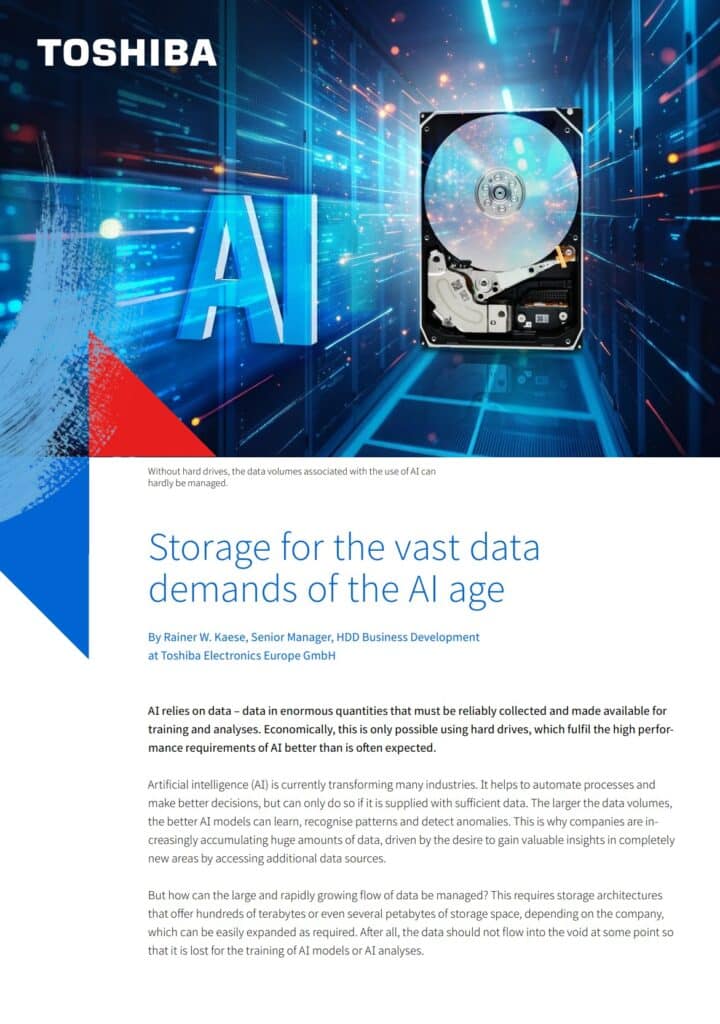
Hard disks are the storage media of choice in these scale-out architectures, as they are the only way to provide the required capacities economically. Flash memory is still around five to eight times more expensive per unit of capacity and is therefore only used in selected areas, for example as a cache or in high-performance systems. In most cases and for the majority of AI data, however, hard disks are sufficient. Indeed, they deliver significantly better performance than companies often assume, especially when combined.
Download the whole article here.
Author: Rainer W. Kaese, Senior Manager, HDD Business Development at Toshiba Electronics Europe GmbH